
The Truth About Burnout and How to Be Proactive with Managing Stress

“Self-care is on of the active ways that I love myself.” - Tracee Ellis Ross
Burnout is not just a cute pop psychology trend.
Burnout is not fun at all. When people discuss wanting to prevent burnout, they're not talking about wanting to avoid feeling a little tired at the end of their day. Burnout is all-consuming. Burnout changes how you feel physically and emotionally, and how you think. Burnout does not feel good.
People have become more vocal about their experiences with burnout over the last few years. More often, you'll hear people say that by the end of their work week, they have nothing left for themselves. They are not able to enjoy their weekend. They're not able to take care of themselves or their home. Forget having a social life!
Burnout shows up as the feeling of suddenly no longer wanting to do something that you've loved doing for so long. It becomes indecisiveness and not being able to make a decision that is supposed to be simple or easy.
Burnout doesn't have a time frame.
People think that you can take a day off from work, or go on a 4 day vacation, and feel like yourself again. Not if you’re burnt out. Once you reach burnout, it becomes a matter of caring for yourself and nursing yourself back to health. Burnout can last a few weeks. It can last for a few months. Some people have reported burnout lasting for multiple years, so yes, it is that serious.
Here are signs that you may be experiencing burnout:
You can’t seem to feel rested no matter how much sleep you get.
You’re struggling to focus or find motivation to start tasks.
You feel like you don’t care about things anymore.
You feel more negative than you’re used to about work, school, yourself, etc.
You may be more susceptible to burnout at certain periods in your life, at various times of the year, or because of the nature of your job or career.
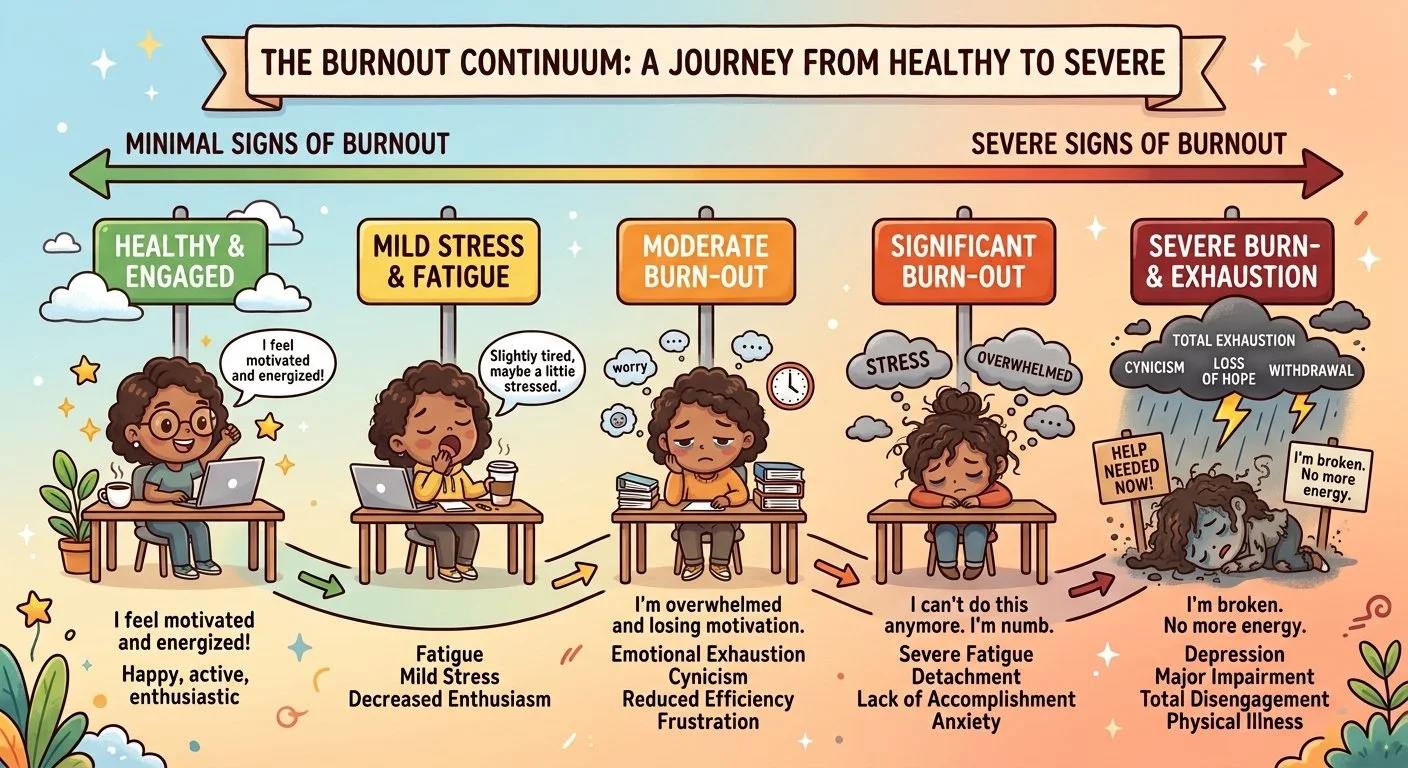
Image created by Jessica Herd, LMHC-D using Google Gemini
A good way to frame burnout is to view it as a continuum rather than an on-and-off switch. At one end of the continuum, let’s say the left side, is the impact of daily stressors and the energy that they take, which feels manageable. On the right side at the other end, either the stressors are more severe or you may have gone too long without proper self-care; this end is where complete depletion and dissociation lives.
I’ve recommended reading Burnout by Emily Nagoski, PhD and Amelia Nagoski, DMA and I still like the way burnout is framed in their book.
Burnout can be experienced as:
“Emotional Exhaustion: Fatigue from caring too much, for too long.”
“Depersonalization: The depletion of empathy, caring, and compassion.”
“Decreased Sense of Accomplishment: An unconquerable sense of futility; feeling that nothing you do makes any difference.”

I created a free checklist that you can use to see where you may currently be on a burnout continuum. Use it to self-reflect on any present symptoms of burnout. Click here to access it.
Here are strategies to use today - start being proactive with stress management:
ABC - Appreciate, Boundaries, Community
Appreciate
Make time everyday -even for a few minutes- to practice gratitude for the things in your life that are outside of work and school.
Your job isn't everything! This semester has an end date!
Giving yourself the chance to focus on those elements of your life, and give thanks for what is going well outside of work or school.
Boundaries
With Self
Know your limits and do not push yourself past them!
Be kind to yourself and carve out time for the things that help you to feel your best.
On the other hand, that also means scheduling enough time for the things you know that you need to get done so that you’re not feeling overwhelmed by piled up tasks.
With Others
Last but certainly not least, learn to say no, as a way to preserve your energy. Over-extending consistently over time can quickly lead to burn out.
Community
Lean on your people.
Do fun things with friends.
Get emotional support from family (or your chosen family).
Laugh. Cry. Dance. Play.
Have you ever experienced burnout? How effective is your self-care routine? Let me know in the comments!
Share this with someone that may be struggling with burning out or feeling overwhelmed.
If you’re interested in participating in a workshop for more ways to build a self-care routine and prevent burnout, let me know!
As Always, Be Well!
Warmly, Jessica Herd, LMHC-D
Jessica Herd, LMHC-D is a board certified licensed therapist accepting new clients in New York, New Jersey, and Florida. Schedule a free consultation call today.
Resources:
National Suicide & Crisis Lifeline: Dial “988”
Text Crisis Line: Text “HELLO” to 741741