
How to Find Relief During Challenging Times

“You don’t have to be positive all the time. It’s perfectly okay to feel sad, angry, annoyed, frustrated, scared, and anxious. Having feelings doesn’t make you a negative person. It makes you human.” — Luvvie Ajayi Jones
These days, it feels like the expectations keep growing and the pressure keeps getting heavier.
There may be milestones that you’re trying so hard to achieve.
There may be a promotion that you’ve been working above and beyond for.
Maybe there’s something that you’ve been waiting on for what feels like an eternity.
Maybe something big is out of your hands, and things just aren’t going your way.
Maybe making ends meet feels impossible these days.
We’ve all been there; sometimes things are outside of our control. We all experience frustrating times.

If you do happen to relate to this:
When you think about your particular situation, what does that feel like in your body?
Do you notice tension in your neck and shoulders?
Does it feel like a heaviness in your stomach?
Can it sometimes manifest as the sensation of your skin crawling, or like wanting to jump out of your body?
Is it more of a restless energy, like you can’t sit still?
Sitting with the feelings can be very uncomfortable.
It’s often easier to avoid it. It’s comforting to fantasize about escaping, or to even partake in activities that help us to do just that.
However things have been feeling for you during this time in your life, I want you to simply acknowledge it and to give yourself grace.
It’s okay to say when something doesn’t feel good for us.
It’s also okay for us to sit with those angry, sad, anxious, etc. feelings.
Here’s a gentle reminder that this is not the time to double down and work yourself to the bone to force things to go your way. It’s also not the time to be self-critical and berate yourself about how far you still have to go or over what isn’t going well.
I want you to practice an alternative to other methods of coping when we feel frustrated, stuck, and overwhelmed.
Let’s practice being in the present moment for a minute.
Take a few deep breaths.
Feel your seat underneath you.
Maybe take a look around you, and list three things you see in your immediate surroundings.
What was that like?
How do you feel at this moment, not thinking about anything else that may have been heavily on your mind lately?
Mindfulness is one way to practice being in the present moment. We can use mindfulness to temporarily take us out of unhelpful thoughts and feelings.
3 Ways to Manage How You’re Feeling When Life Feels Frustrating and Overwhelming:
Mindfulness
Mindfulness is an intentional practice of paying attention to elements of the present moment; that can be your surroundings, your body, your emotions, or your thoughts. The most important thing to remember is to not judge what it is that you are observing.
When we practice mindfulness, we create a bit of psychological space between our internal world and experiences, and our current environment.
How to practice mindfulness today, or this week:
When you’re drinking your morning coffee or tea, or once you’ve opened your laptop for the day, just take 2-5 minutes to pay attention to how your body is feeling, how you’re breathing, and any emotions you may be experiencing.
Self-Expression
Self-expression is when we communicate internal thoughts, emotions, experiences, and needs through verbal, written, physical, or artistic and creative outlets.
Giving your emotions an appropriate outlet can help you process what happened, better understand what you’re feeling, and organize your thoughts. It can feel incredibly meaningful to channel your emotions into art, music, or dance.
How to practice self-expression today, or this week:
Schedule time to write in your journal today. Schedule one or two opportunities to express yourself this week or weekend, such as taking a dance class.
Visualization
Visualization is when we intentionally think about calming, supportive, or goal-directed images and experiences in our mind. It can be helpful to participate in guided imagery, where you follow prompts being read aloud to you.
Instead of our mind’s default to imagine all the ways things can go wrong, or how things may never change, we can shift the tone to a more positive tone from a negative perspective.
It helps us to redirect our thoughts to ones that are more beneficial and build confidence.
How to practice visualization today, or this week:
Plan for 5 minutes where you can comfortably sit with yourself. A good choice could be at bedtime. Close your eyes and picture a place where you feel safe, grounded, and relaxed. Be detailed with your image; what can you see? What sounds can you hear? What is the temperature like? Do you notice any sensations?
Healthy coping strategies help us to tolerate or move through our intense emotions. The goal isn’t to eliminate our feelings, but it makes living with our current reality a bit better.
I hope that this was helpful!
As Always, Be Well!
Jessica Herd, LMHC-D
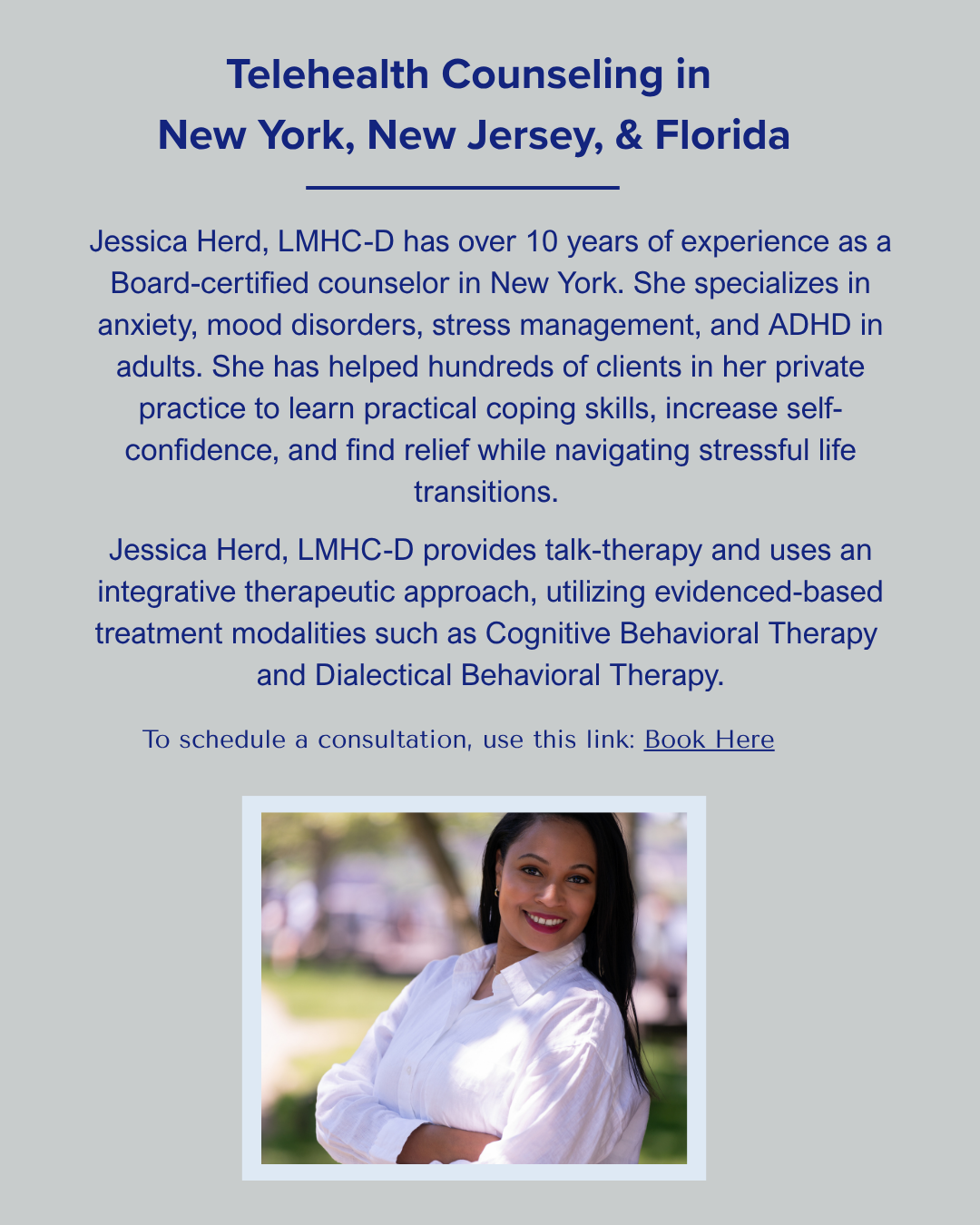
Jessica Herd, LMHC-D is a licensed therapist offering therapy to adults in New York, New Jersey, and Florida. Book a free consultation call today.
Resources:
National Suicide & Crisis Lifeline: Dial “988”
Text Crisis Line: Text “HELLO” to 741741